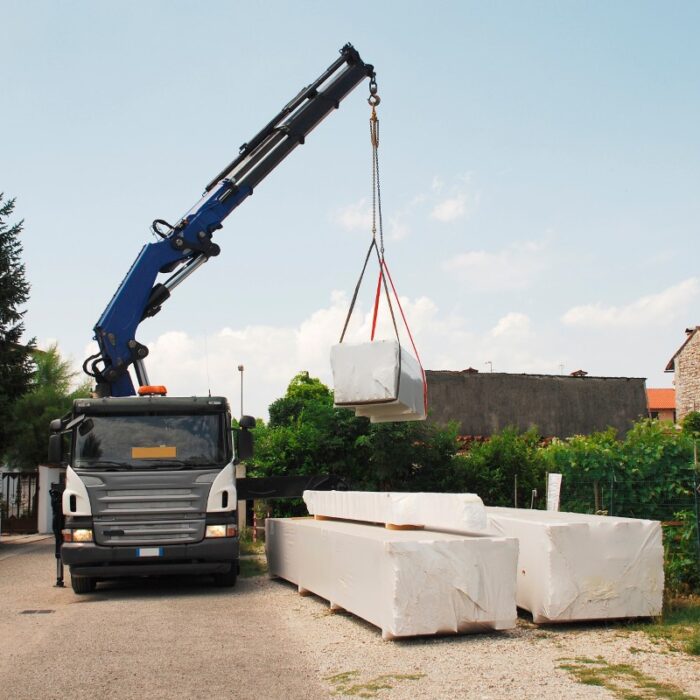
Crane truck: Get a free price quote • Quick response
Do you need a crane truck?
We’ll help you find a reliable crane truck company in your area. Do you need help moving heavy objects, transporting vehicles or lifting heavy equipment? We connect you with professional crane truck companies that have the right equipment for your job.
Fill in the form on the page with details of the load, pick-up location, delivery address and desired time. We’ll quickly find a reputable crane truck company with the right capacity to solve your task in a safe and efficient way.
Get a free quote from a crane truck company
Send us a short description of your wishes and needs, and we’ll help you find the most suited crane truck company.
Your contact information will only be used in connection with the request. Your personal data will not be disclosed to unauthorized persons.
Three simple steps to get a quote for your crane truck task:
1. Send a request
Send us a request with a short description of your wishes and needs.
All requests about crane truck tasks are processed as soon as possible.
2. Receive your free quote
You will receive a free and non-binding price quote from a crane truck company near you soon after your request has been sent.
Once you approve the price quote, a suitable time for performing the task is scheduled.
3. The task is performed
The transport company will perform the task to a high standard of quality, in accordance with industry standards and local regulations.
BestilleTransport.no partners with skilled and qualified crane truck companies all across Norway.
How BestilleTransport.no works
We know that you’re concerned about quality, price and service when choosing a crane truck for your assignment.
We’ve made it easy for you – send us a request with a description of your assignment and we’ll find a quality-assured crane truck company that’s right for you.
The goal of BestilleTransport.no is that you should not have to spend a lot of time assessing all the different crane truck companies that take on assignments in your area.
Get quick feedback with a free, no-obligation quote from a crane truck company in your area.
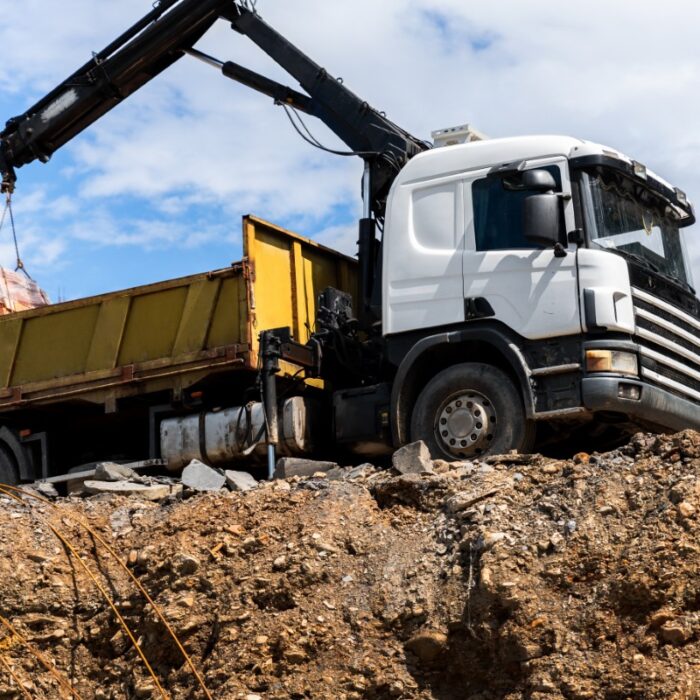
Quotes for crane trucks through BestilleTransport.no
Receive a quote for a crane truck for your assignment.
BestilleTransport.no is a service that helps you find the crane truck company that suits your wishes and needs. We collaborate with skilled and qualified crane truck companies throughout the country that take on assignments of most sizes. Fill in the form with your contact information and your needs and wishes, and you will be contacted by a crane truck company that is suitable for your assignment within a short time.
What is a crane truck and what is it used for?
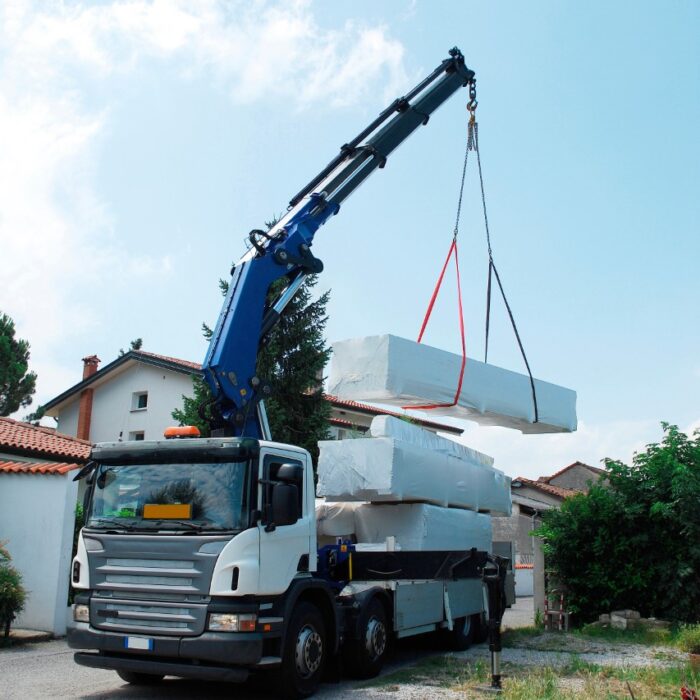
A crane truck is a specially designed vehicle that combines a truck with a mounted crane. This powerful combination makes it possible to both transport and lift heavy loads. The crane truck is built on a truck chassis with a hydraulic crane attached to the frame, usually behind the cab or on the loading platform.
Crane trucks are mainly used to lift and move heavy objects such as building materials, containers, machines, barracks, and other large objects that are too heavy for manual handling. The crane truck can be used to pick up and deliver loads in locations that are difficult to access for other vehicles, and the operator can control the crane with precision for accurate positioning.
In the construction industry, crane trucks are particularly useful for transporting and lifting building materials to high floors, while in industry they are often used to move machinery and equipment. Private individuals often order crane truck services when they need to move heavy objects such as hot tubs, boats, or large garden features.
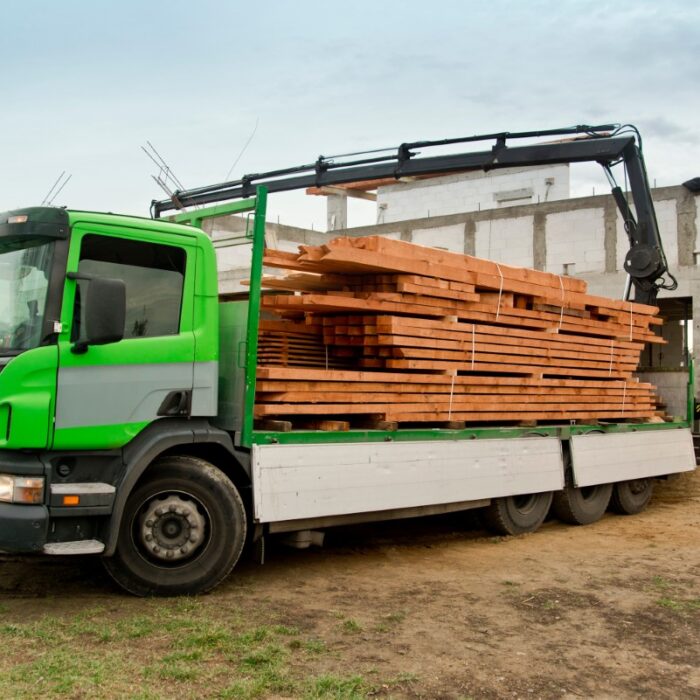
Different types of crane trucks and their uses
Truck-mounted crane: This is the most common type of crane truck and consists of a crane mounted on a standard truck. These are flexible and can both transport and lift materials. They are ideal for delivering building materials, moving containers, and general lifting tasks.
Mobile crane: Mobile cranes are specialized vehicles where the entire vehicle is designed as a crane. They have greater lifting capacity than truck-mounted cranes and are used for heavier industrial tasks, construction work, and the assembly of larger structures.
All-terrain crane: These are designed to operate in rough terrain where regular crane trucks cannot reach. They have special wheels or tracks that provide good mobility on construction sites, in forest areas, or other challenging areas.
Telescopic crane: Known for their telescopic arm that can be extended to reach high areas. They are particularly useful in urban environments where there is a need to lift to great heights with limited space on the ground.
Articulated boom crane: These cranes have a joint that allows the arm to “bend,” providing increased flexibility when maneuvering the load around obstacles. They are popular for delivering building materials to tight construction sites.
Why choose a crane truck over other lifting options?
Mobility and flexibility
Unlike fixed cranes, truck-mounted cranes can quickly move between different locations. This makes them ideal for projects that require lifting at multiple locations or for single assignments at different locations.
Save time and labor
With a truck-mounted crane, tasks that would otherwise require several workers and a lot of time can be performed efficiently by a single operator. This results in significant savings in both time and money.
Precision positioning
Modern crane trucks are equipped with advanced control systems that allow the operator to position heavy objects with millimeter precision, which is important when installing prefabricated building elements, for example.
Access to difficult areas
Crane trucks can lift loads over obstacles and to locations that would otherwise be inaccessible, such as over buildings, down into shafts or up to high floors.
Handling heavy loads
Crane trucks can handle objects that are too heavy for manual moving or other lifting methods, with lifting capacities ranging from a few tons to several hundred tons for the largest models.
Get a quote
Send us a request, and we’ll get you a free quote from a transport company.
How much does it cost to rent a crane truck?
The prices for renting a crane truck vary considerably based on several factors, and it can be difficult to give an exact price estimate without knowing the details of the specific job. The costs depend on everything from the size and capacity of the crane to the duration and complexity of the job. For many people planning a project, however, it is still useful to have a general understanding of the price level in order to budget realistically.
Here is an overview of the most important price factors and some indicative prices.
Factors that affect the rental price
- Crane size and type: The most obvious factor affecting the price is the type and size of crane truck you need. Larger cranes with higher lifting capacities cost significantly more than smaller models.
- Duration of the job: Most crane truck companies operate on an hourly rate. Short assignments often have a minimum price (typically 2-4 hours), while longer assignments may offer discounted hourly rates.
- Geographical location: Price levels vary between different parts of the country. Prices are generally higher in larger cities than in rural areas. In addition, there are transport costs for getting the crane truck to and from the job site.
- Season and demand: During the peak season for construction (typically spring to fall), prices may be higher due to increased demand. The same applies to orders placed at short notice.
- Preparation time and planning: Complex jobs that require thorough planning, site inspection or special adaptations will incur additional costs beyond the pure operating time.
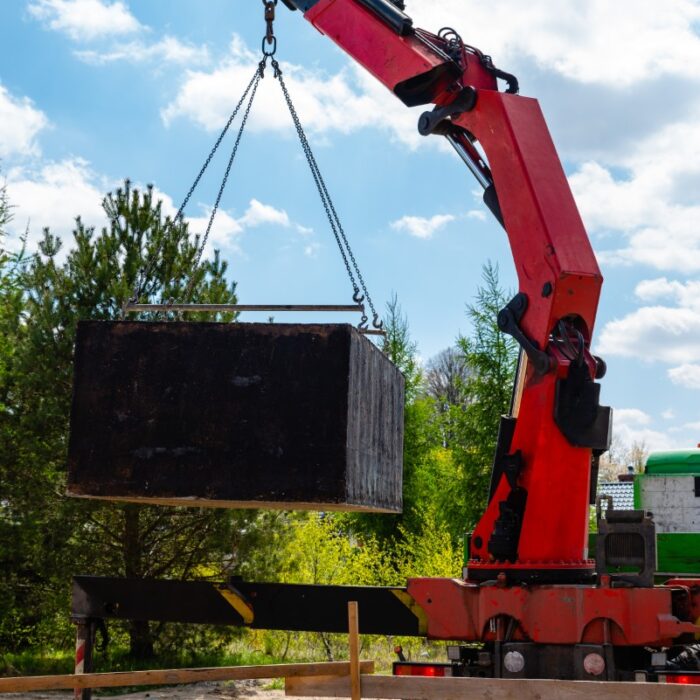
Average hourly rates based on crane size
Here are some indicative hourly rates for different crane sizes:
Small crane trucks (10-25 tons): For smaller crane trucks, the hourly rate is typically between NOK 900 and 1,700. These are suitable for lighter lifting such as building materials, smaller machines or garden furniture.
Medium-sized crane trucks (25-50 tons): Medium-sized cranes typically cost between NOK 1,500 and NOK 2,500 per hour. These are often used for lifting containers, hot tubs, smaller prefabricated building components or boats.
Large crane trucks (50-100 tons): For larger crane trucks with high lifting capacity, the hourly rate is usually NOK 2,500-5,000. These are used for heavier industrial lifting, larger building elements or heavy machinery.
Special and mobile cranes (over 100 tons): Special cranes with extreme lifting capacity can cost from NOK 5,000 and up per hour, depending on size and capacity.
Additional costs that may apply
When renting a crane truck, it is important to be aware that additional costs may be added to the basic hourly rate:
Transport costs
The cost of getting the crane truck to and from the job site is often calculated separately, either as a fixed rate or based on the distance traveled.Set-up time
The time it takes to set up the crane, mount the support legs and prepare for lifting, as well as pack up afterwards, is usually invoiced at the same hourly rate as the lifting work itself.Special equipment
Additional lifting equipment, special slings, lifting platforms or other additional equipment often incur extra costs.Permits and escort vehicle
For larger cranes or special transport, transport permits from the Norwegian Public Roads Administration and, if necessary, an escort vehicle may be required, which entails additional costs.Operator overtime
Assignments outside normal working hours, on weekends or public holidays will incur overtime charges, typically 50-100% of the regular hourly rate.
How to choose the right crane truck for your project
Choosing the right crane truck is important for a successful project. A crane truck that is too small will not be able to perform the task, while an oversized crane will result in unnecessary costs. Careful planning and assessment of the project requirements are therefore important.
Factors such as load weight, lifting height, space conditions and access to the work site must be thoroughly assessed. By thinking through these elements in advance, you can ensure efficient and safe completion of the lifting task while keeping costs down.
Consider lifting height and reach
Lifting height and reach are two critical factors that must be considered before choosing a crane truck:
Maximum lifting height
Find out exactly how high the crane needs to be able to lift. Remember to include the height of the object to be lifted in your calculation.
It is better to have a little extra margin than to discover that the crane cannot reach when it is in position.
Calculate the required reach
Measure the distance from where the crane truck can be positioned to where the load needs to be lifted. Remember that the further out the crane has to extend, the less lifting capacity it will have.
This is called the load chart and varies between different crane models.
Deal with obstacles
Consider any obstacles that the crane will have to lift over or around, such as buildings, trees or power lines. This may require a longer reach or a crane with special functionality.
Combine height and reach
Remember that a crane’s maximum reach and maximum lifting height can rarely be achieved at the same time. The further out the crane extends, the lower the maximum lifting height, and vice versa.
Determine the required lifting capacity
The correct lifting capacity is important for both safety and efficiency:
Know the exact weight of the load
Obtain accurate information about the weight of the object to be lifted. If you are unsure, it is always best to round up.
Include the weight of lifting equipment
Remember that the weight of slings, chains, lifting beams and other equipment used for lifting must be added to the weight of the load to calculate the total lifting capacity.
Add a safety margin
It is good practice to choose a crane with at least 20% higher capacity than the calculated total weight to allow for a safety margin.
Understand the load chart
A crane’s lifting capacity decreases with increasing reach. Take a closer look at the crane’s load chart to make sure it can lift your load at the required distance.
Consider the available space at the job site
Space is often a limiting factor when choosing a crane truck:
Accessibility
Check that there is sufficient space for the crane truck to reach the job site. Measure gate openings, road width and turning radius where necessary.
Calculate the set-up space
Crane trucks need stable and level ground for set-up. Make sure there is sufficient space to extend the support legs, which can extend several meters from the vehicle.
Check the load-bearing capacity of the ground
Check that the ground can support the weight of the crane truck with a full load. On soft ground, extra mats or plates may be required under the support legs.
Maneuvering space
Also consider whether there is enough space for the crane to rotate and maneuver during the lifting operation without encountering obstacles.
Reach and lifting capacity of a crane truck
The reach and lifting capacity of a crane truck are two of the most important characteristics that determine the tasks it can perform. These factors vary significantly between different crane models and sizes, and it is important to understand the limitations and possibilities in order to choose the right crane truck for the job. Modern crane trucks are impressive machines that combine mobility with powerful lifting capabilities, but they always operate within well-defined physical limits that are carefully calculated by manufacturers to ensure safe operation.
How reach varies with crane size
The reach of a crane truck is directly affected by the size and design of the crane:
- Small crane trucks (10-25 tons): Smaller crane trucks typically have a telescopic boom reach of 7-20 meters. These cranes are built for mobility and maneuverability rather than extreme reach and are ideal for precise lifting over shorter distances.
- Medium-sized crane trucks (25-50 tons): Medium-sized crane trucks can have a reach of 20-35 meters. Many of these are equipped with telescopic booms that can be extended for increased reach when necessary.
- Large crane trucks (50-100 tons): Larger crane trucks offer ranges of 35-60 meters, making them suitable for work on tall buildings or over wide obstacles. Some models also have jibs (extra boom extensions) that can further increase the range.
- Special cranes (over 100 tons): The largest cranes can have ranges of 60-100 meters or more with fully extended telescopic booms and jibs. These are used for special assignments such as the installation of wind turbines or work on tall industrial plants.
Examples of lifting capacity for different crane trucks
Lifting capacity varies considerably between different crane truck models:
- Truck-mounted cranes (hook lifts): The smallest truck-mounted cranes have a lifting capacity of 1-10 tons at minimum reach. These are primarily used for loading and unloading trucks.
- Small mobile cranes: Small mobile cranes with a capacity of 10-30 tons are versatile and can handle many common lifting tasks such as moving containers, small machines, and building materials.
- Medium mobile cranes: Cranes in the 30-70 ton class can lift heavy machinery, prefabricated building elements and other heavy components. They offer a good balance between lifting capacity and mobility.
- Heavy mobile cranes: Large mobile cranes with a capacity of 70-200 tons are used for assembling large industrial machines, bridge sections and other very heavy components.
- Super cranes: Specialized cranes with a capacity of several hundred tons are used for the heaviest lifts in infrastructure, offshore and heavy industry.
Get a quote for crane truck rental or transport
Are you looking for a reliable crane truck for your next project? Through bestiltransport.no, you can easily get in touch with professional crane truck companies across the country. We work with a nationwide network of reputable operators offering everything from small truck cranes to larger mobile cranes for heavier lifting.
When you submit a request to us, we will quickly forward it to a crane truck company in your area that has the right equipment and expertise for the job. The selected provider will then contact you directly with a quote tailored to your needs.